Flying the Flag
Call me patriotic, call me jingoistic or just call me a lover of the American Flag, but it is a truly beautiful flag. It is simple in its design and, yet, complex in its symbolic meaning. The stripes in our country's flag truly reflect the beginnings of a unique experiment in democracy and, yet again, the stars reflect our Union's accomplishments in today's world.
Our country has accomplished many amazing quests in over two hundred and thirty years. The United States flag has flown in some interesting places at the ends of the Earth like the North Pole or the bottom of the ocean and so, it is not surprising that astronauts take the US flag into Space.
The United States flags shown in this exhibit journeyed into Space, but six flags journeyed to an even more unique place on Mankind's greatest expedition of the 20th Century on a voyage to the Moon.
The Apollo Project flew eleven missions from 1968 to 1972. Six of the eleven mission landed on the Moon. The project represented a feat of peacetime engineering that has yet to be rivaled even into the 21st Century.
 As with any great journey, it starts with a step forward. After the disastrous Apollo 1 fire, Apollo 7 rose for the ashes to perform a successful test flight of the newly redesigned Apollo Command Module. The crew of Wally Schirra, Don Eisele and Walt Cunningham took the American flag back into orbit after an 18 month hiatus.
 Walt Cunningham kept this flag in his personal collection since that flight in 1968. The flag is attached to a standard NASA presentation page of that era. What is difference from other presentations of this type is the pristine condition of the entire presentation as well as a photograph of the crew attached to the display. Walt has inscribed the flag as being flown on the Apollo 7 mission.
 Apollo 7's near perfect mission lead NASA to take a momentous gamble to beat the Russians to lunar orbit by the decision to launch Apollo 8 to the Moon. On this first mission to leave the gravitational bounds of Earth, Frank Borman, James Lovell and William Anders brought the flag to further from our home planet then had been done before.
 This flag presentation shows its age with some yellowing on the paper display and the discoloration of the double sided tape used to adhere the flag to the page. In June of 2007, Jim Lovell signed the flag at the Kennedy Space Center. Capt Lovell commented on the flag presentation. He remembered the three astronauts sitting down and signing all of these presentations.
 The United States had proved that they could orbit the Moon. The next giant step was to land on the Moon, but there were still a few smaller steps to ahead.
One of those steps was to test the vehicle that would land on the Moon. The first major in-flight demonstration of the lunar lander was Apollo 9. This flight would test the Lunar Module (LM) by simulating all the major events of a lunar landing in Earth orbit. The hope was to prove the LM's capability to function in space. It was a extremely complex mission and the crew of James McDivitt, David Scott and Rusty Schweikert would preform it flawlessly. Thus paving the way for another step to a lunar landing.
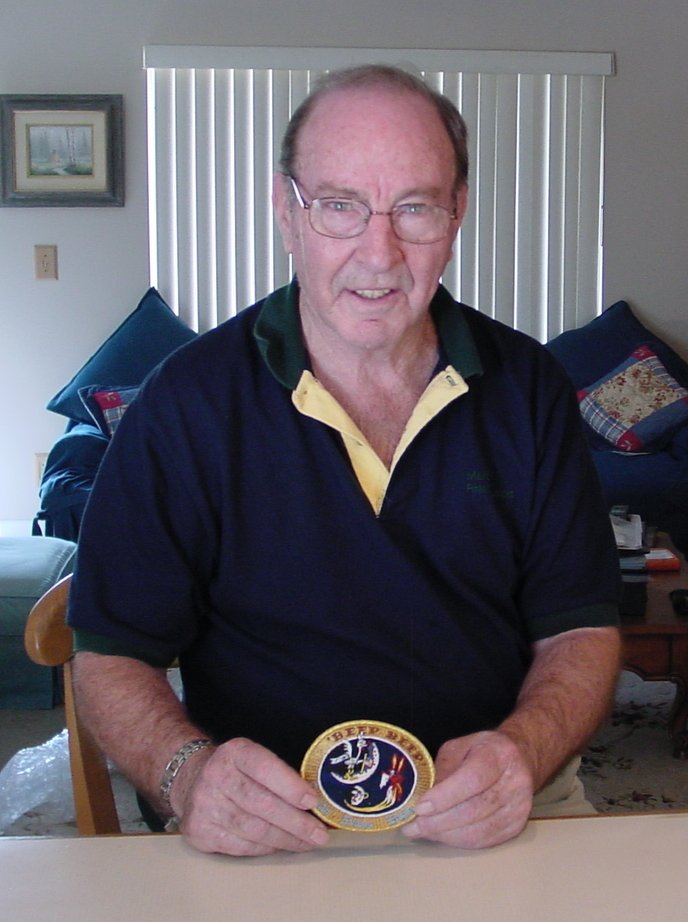
 Apollo 9 carried very little in the way of mementos from the flight, but the flag was there. In September of 2004, I had the pleasure of meeting Dave Scott in Los Angeles. There I showed him the flag shown in the two photographs shown about. The flag had been signed by David previously and the prior owner removed the flag from an old presentation and attached it to a acid free matte.
 The final flight test prior to a landing on the Moon was the mission of Apollo 10. Apollo 9 had demonstrated that the LM was flight rated for space travel. Due to several reasons including the need to test the communication systems and lunar rendezvous, Apollo 10 would journey to the Moon and perform descent, rendezvous and docking while in lunar orbit. In a nod to Charles Schultz's comic strip"Peanuts, the strip's two main characters and their use as mascots for the Manned Spaceflight Awareness Program, the crew of Thomas Stafford, John Young and Eugene Cernan would name their Command Module "Charlie Brown and the Lunar Module "Snoopy." Snoopy would descend to within 50,000 feet of the lunar surface and then return to Charlie Brown for the trip home. The flight, while being called a "Dress Rehearsal," was the accomplishment of another very difficult step to lunar landing.
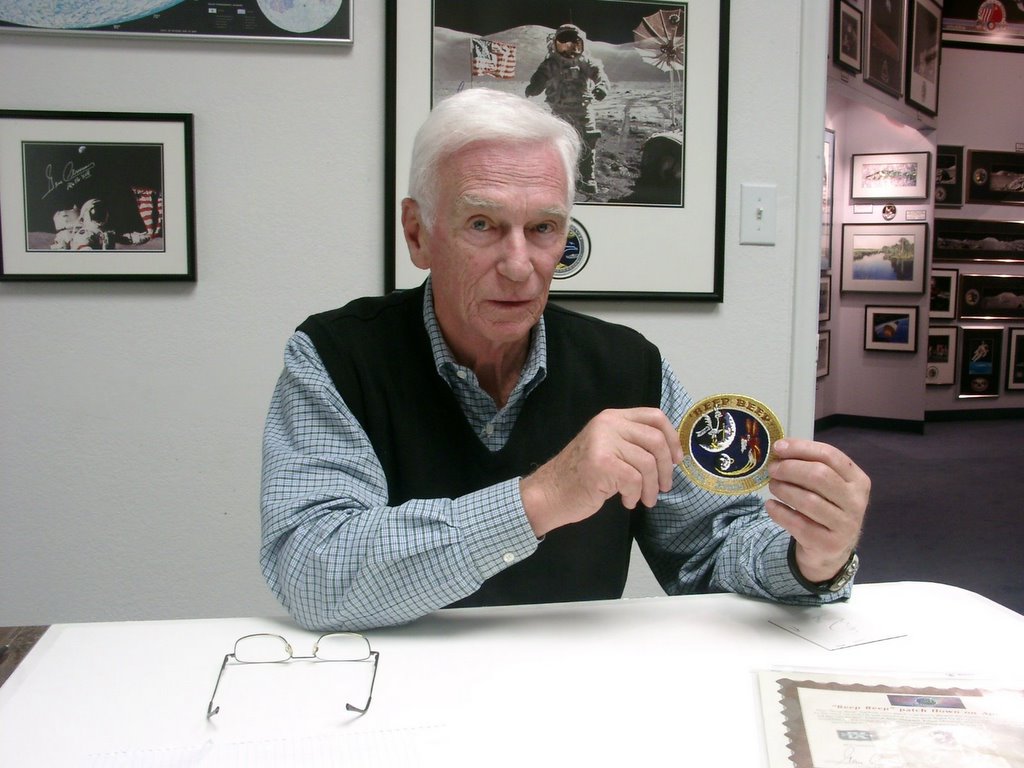
 The Apollo 10 flag presentation shows what lack of care can do to these displays over time. The prior owner, who received the flag during a presentation ceremony with the crew, framed and hung the display in his home in direct Floridian sunlight. The display seriously darkened over the decades. The signatures faded and the owner tried to redo the signatures with a Sharpie at some point during his ownership. In 2005, I showed Gene Cernan the flag display and the gentleman's presentation plaque that came with the display. Gene recognized the name and remembered the ceremony where the crew attended and presented flown flags to NASA support people who provided outstanding performances during the Apollo 10 mission.
The US flag again accompanied the mission. By this time, the process of bringing the flag to space had been perfected. Under NASA review, flags were vacuum packed into clean room plastic bags with a unique pink tint. The "pink" bags were then placed in the command module by the support crew prior to the launch. Once the mission was complete, the bags would be removed from the spacecraft. Eventually, the flags would be mounted on a standardized presentation as shown in the above photograph. Then the crew would either sign or personalize the presentations (as was done on the Apollo 8 flag presentation artifact shown above) as gifts to VIPs and members of the ground support team.
The Apollo 7, Apollo 8 and the Apollo 10 flags are mounted on the NASA standard presentation display of that era. The three presentations also show the various stages of deterioration that occurs over time. Walt Cunningham maintains his displays away from sunlight and the presentation reflects that care as it is still white. The Apollo 8 presentation shows average aging of these displays. The page has slightly darkened and the double sided tape used to attach the flag to the presentation has darkened and bled through the flag. The Apollo 10 display shows extremely aging, but also reflects the fact that the recipient of the flag proudly displayed this flag prominently in his house during his life.
 The final step of landing on the Moon was accomplished by the Apollo 11 mission. The lunar module, codenamed "Eagle," journeyed the last 50,000 feet from low lunar orbit to the surface of the Moon at a place called Tranquility Base on the Sea of Tranquility. With the crew of Apollo 11, so landed the American flag. The first and only flag flown by man to another world. The crew consisting of Neil Armstrong, Michael Collins and Buzz Aldrin carried US flags and the flags of other countries in both their "Personal Preference Kit" (PPK) bags as well as in the NASA flight kit (those pink colored clean room bags). The current number of flown US flags is not been officially announced by NASA and it is unknown to this author what is the actual number of US flags flown to the Moon on the Apollo 11 flight.
The above flag was part of a presentation Buzz Aldrin made to a Vietnam US prisoner of war. Buzz has inscribed the flag , since it was from his collection. The prior owner detached the flag from the presentation and stitched to an acid free cloth backing to the flag to prevent it from deteriorating.
 The prior owner also took the time to privately meet with Buzz in Washington, DC. in 1999 to pose for with the flag.
 Apollo 12 was the second flight to plant the American flag on the lunar surface. This all Navy crew of Charles Conrad, Richard Gordon and Alan Bean carried several different size flags to the Moon. The most notable is the largest type of flag flown to the lunar surface. The US flag shown above is approximately 12 inches by 17 inches and was flown to the Ocean of Storms about the lunar module "Intrepid" in November of 1969. It estimated that only twenty large format flags were carried to the lunar surface on all the Moon landings.
I procured the flag directly from the collection of the command module pilot, Dick Gordon. The crew had all their flags placed on presentation boards soon after their flight was completed. Dick inscribed the flag presentation board that also has a small typed plaque that reads, "Sailed with Yankee Clipper and Intrepid to the Ocean of Storms, November 1969."
 In 2007, I visited Alan Bean at his art studio. The renowned artist inscribed and signed the flag. Then posed with me and the flag. There are examples of his work on the easels behind us. Two of the paintings represent the first man and the second man to walk on the Moon.
Just a short note about flag sizes that the various crews carried to the Moon. There were three sizes. They were labeled small, medium and large on the astronaut's PPK lists. The small flag was four by six inches. The medium sized flag was eight by ten inches. While the large flag was twelve by seventeen inches.
 Apollo 13 never landed on the Moon. As NASA's "successful failure," the crew of James Lovell, Jack Swigert and Fred Haise were saved by the determination of the personnel on the ground and their own ability to avoid panic in a life threatening situation.
 Once they safely returned from space, they commissioned the Scheduling Office and it's supervisor, Bill Whipkey to design a VIP presentation for their mission. Bill created the above presentation that included a flown flag, flown beta patch and a flown piece of webbing from the lunar module, Aquarius. The crew signed the bottom of each presentation. Bill received two such displays and this one is certified and signed by Fred Haise.
 All flown flags are not American flags. Although Uncle Sam's "Stars and Stripes" is by far the most popular flag in the public's mind. The astronauts flew flags from other countries as well as flags from all the states in the Union.
As a resident of the State of Massachusetts, I am partial to the state's flag. I was able to procure one such example directly from Edgar Mitchell, the Lunar Module Pilot on Apollo 14. The flag along Edgar's other crewmates, Alan Shepard and Stu Roosa traveled to the Moon in the command module "Kitty Hawk." Later Alan and Edgar would land at Fra Mauro and would make the longest "walk" ever performed on the lunar surface.
 I journeyed to Edgar's home to pick up the flag, take a certification photo and to sit with him to talk about his experiences.
 Apollo 15 was the first "J" mission launched to the Moon. This mission was the first to include a lunar rover as a means to explore farther from the initial landing site. The landing site of Hadley Rille and the Apennine Mountains certainly added to the splendor of the mission. The crew of David Scott, Al Worden and James Irwin would undertake what is considered the greatest scientific mission on the Moon.
The United States flag shown above is directly from Al Worden's private collection and has Al's certification on it.
 Al and I met in Denver in 2007, where I was able to photographically document Al with the above flag and written certification.
 Apollo 16 pushed the boundaries of lunar knowledge even further with a landing in the Descartes Highlands. Their mission would prove the need for Man's presence in scientific exploration of the Solar System. John Young, Ken Mattingly and Charlie Duke's work would change some of the pre-conceived theories of lunar origin.
They also had drove their rover in the first and only Lunar "Gran Prix" and performed in the lunar Olympics. This mission would also set the record for the highest traverse on the Moon, when John and Charlie drove their rover up the side of Stone Mountain near their landing site.
The above flag presentation was designed by Charlie Duke himself. The flag was flown directly to the lunar surface about the lunar module, "Orion."
 I traveled to Charlie's home in 1999 to have him certify the flag as a surface flown flag. We are standing in his home with the presentation and the certification letter that he provided with the display.
 As the final mission to the Moon so far, Apollo 17 touched down in the Taurus-Littrow region on the Moon. The crew of Gene Cernan, Ronald Evans and Harrison Schmitt would close out the first manned exploration of the Moon in 1972. Man has not journeyed beyond low earth orbit ever since.
This flag presentation is of interest, since it was presented to Howard Benedict, a reporter for Associated Press. Howard covered the Space Race from before America's first manned launch to the Shuttle era. Howard became friends with many of the nation's astronauts and most notably with America's first man in space, Alan Shepard. Howard would later become the executive director of the Astronaut Scholarship Foundation.
The display presented to Howard upon his retirement from the Associated Press. The presentation was signed by 34 astronauts and includes the first American in space and the last man to walk on the Moon.
 In the winter of 2005, I bought the display to Gene Cernan. The flag used in the presentation was an Apollo 17 flag. Gene remembered Howard well. Gene even remember the retirement presentation. I had learned that Howard had donated the presentation to a fund raising event for the ASF and it eventually found its way to my collection. Gene certified the flag and posed for this photograph. Thus completing a unique era in exploration.
Indeed these flags have made some remarkable journeys. They represented the United States when the nation showed the world its technological excellence and sent explorers beyond Earth's grasp to land on the Moon.
Our country has accomplished many amazing quests in over two hundred and thirty years. The United States flag has flown in some interesting places at the ends of the Earth like the North Pole or the bottom of the ocean and so, it is not surprising that astronauts take the US flag into Space.
The United States flags shown in this exhibit journeyed into Space, but six flags journeyed to an even more unique place on Mankind's greatest expedition of the 20th Century on a voyage to the Moon.
The Apollo Project flew eleven missions from 1968 to 1972. Six of the eleven mission landed on the Moon. The project represented a feat of peacetime engineering that has yet to be rivaled even into the 21st Century.
 As with any great journey, it starts with a step forward. After the disastrous Apollo 1 fire, Apollo 7 rose for the ashes to perform a successful test flight of the newly redesigned Apollo Command Module. The crew of Wally Schirra, Don Eisele and Walt Cunningham took the American flag back into orbit after an 18 month hiatus.
 Walt Cunningham kept this flag in his personal collection since that flight in 1968. The flag is attached to a standard NASA presentation page of that era. What is difference from other presentations of this type is the pristine condition of the entire presentation as well as a photograph of the crew attached to the display. Walt has inscribed the flag as being flown on the Apollo 7 mission.
 Apollo 7's near perfect mission lead NASA to take a momentous gamble to beat the Russians to lunar orbit by the decision to launch Apollo 8 to the Moon. On this first mission to leave the gravitational bounds of Earth, Frank Borman, James Lovell and William Anders brought the flag to further from our home planet then had been done before.
 This flag presentation shows its age with some yellowing on the paper display and the discoloration of the double sided tape used to adhere the flag to the page. In June of 2007, Jim Lovell signed the flag at the Kennedy Space Center. Capt Lovell commented on the flag presentation. He remembered the three astronauts sitting down and signing all of these presentations.
 The United States had proved that they could orbit the Moon. The next giant step was to land on the Moon, but there were still a few smaller steps to ahead.
One of those steps was to test the vehicle that would land on the Moon. The first major in-flight demonstration of the lunar lander was Apollo 9. This flight would test the Lunar Module (LM) by simulating all the major events of a lunar landing in Earth orbit. The hope was to prove the LM's capability to function in space. It was a extremely complex mission and the crew of James McDivitt, David Scott and Rusty Schweikert would preform it flawlessly. Thus paving the way for another step to a lunar landing.
 Apollo 9 carried very little in the way of mementos from the flight, but the flag was there. In September of 2004, I had the pleasure of meeting Dave Scott in Los Angeles. There I showed him the flag shown in the two photographs shown about. The flag had been signed by David previously and the prior owner removed the flag from an old presentation and attached it to a acid free matte.
 The final flight test prior to a landing on the Moon was the mission of Apollo 10. Apollo 9 had demonstrated that the LM was flight rated for space travel. Due to several reasons including the need to test the communication systems and lunar rendezvous, Apollo 10 would journey to the Moon and perform descent, rendezvous and docking while in lunar orbit. In a nod to Charles Schultz's comic strip"Peanuts, the strip's two main characters and their use as mascots for the Manned Spaceflight Awareness Program, the crew of Thomas Stafford, John Young and Eugene Cernan would name their Command Module "Charlie Brown and the Lunar Module "Snoopy." Snoopy would descend to within 50,000 feet of the lunar surface and then return to Charlie Brown for the trip home. The flight, while being called a "Dress Rehearsal," was the accomplishment of another very difficult step to lunar landing.
 The Apollo 10 flag presentation shows what lack of care can do to these displays over time. The prior owner, who received the flag during a presentation ceremony with the crew, framed and hung the display in his home in direct Floridian sunlight. The display seriously darkened over the decades. The signatures faded and the owner tried to redo the signatures with a Sharpie at some point during his ownership. In 2005, I showed Gene Cernan the flag display and the gentleman's presentation plaque that came with the display. Gene recognized the name and remembered the ceremony where the crew attended and presented flown flags to NASA support people who provided outstanding performances during the Apollo 10 mission.
The US flag again accompanied the mission. By this time, the process of bringing the flag to space had been perfected. Under NASA review, flags were vacuum packed into clean room plastic bags with a unique pink tint. The "pink" bags were then placed in the command module by the support crew prior to the launch. Once the mission was complete, the bags would be removed from the spacecraft. Eventually, the flags would be mounted on a standardized presentation as shown in the above photograph. Then the crew would either sign or personalize the presentations (as was done on the Apollo 8 flag presentation artifact shown above) as gifts to VIPs and members of the ground support team.
The Apollo 7, Apollo 8 and the Apollo 10 flags are mounted on the NASA standard presentation display of that era. The three presentations also show the various stages of deterioration that occurs over time. Walt Cunningham maintains his displays away from sunlight and the presentation reflects that care as it is still white. The Apollo 8 presentation shows average aging of these displays. The page has slightly darkened and the double sided tape used to attach the flag to the presentation has darkened and bled through the flag. The Apollo 10 display shows extremely aging, but also reflects the fact that the recipient of the flag proudly displayed this flag prominently in his house during his life.
 The final step of landing on the Moon was accomplished by the Apollo 11 mission. The lunar module, codenamed "Eagle," journeyed the last 50,000 feet from low lunar orbit to the surface of the Moon at a place called Tranquility Base on the Sea of Tranquility. With the crew of Apollo 11, so landed the American flag. The first and only flag flown by man to another world. The crew consisting of Neil Armstrong, Michael Collins and Buzz Aldrin carried US flags and the flags of other countries in both their "Personal Preference Kit" (PPK) bags as well as in the NASA flight kit (those pink colored clean room bags). The current number of flown US flags is not been officially announced by NASA and it is unknown to this author what is the actual number of US flags flown to the Moon on the Apollo 11 flight.
The above flag was part of a presentation Buzz Aldrin made to a Vietnam US prisoner of war. Buzz has inscribed the flag , since it was from his collection. The prior owner detached the flag from the presentation and stitched to an acid free cloth backing to the flag to prevent it from deteriorating.
 The prior owner also took the time to privately meet with Buzz in Washington, DC. in 1999 to pose for with the flag.
 Apollo 12 was the second flight to plant the American flag on the lunar surface. This all Navy crew of Charles Conrad, Richard Gordon and Alan Bean carried several different size flags to the Moon. The most notable is the largest type of flag flown to the lunar surface. The US flag shown above is approximately 12 inches by 17 inches and was flown to the Ocean of Storms about the lunar module "Intrepid" in November of 1969. It estimated that only twenty large format flags were carried to the lunar surface on all the Moon landings.
I procured the flag directly from the collection of the command module pilot, Dick Gordon. The crew had all their flags placed on presentation boards soon after their flight was completed. Dick inscribed the flag presentation board that also has a small typed plaque that reads, "Sailed with Yankee Clipper and Intrepid to the Ocean of Storms, November 1969."
 In 2007, I visited Alan Bean at his art studio. The renowned artist inscribed and signed the flag. Then posed with me and the flag. There are examples of his work on the easels behind us. Two of the paintings represent the first man and the second man to walk on the Moon.
Just a short note about flag sizes that the various crews carried to the Moon. There were three sizes. They were labeled small, medium and large on the astronaut's PPK lists. The small flag was four by six inches. The medium sized flag was eight by ten inches. While the large flag was twelve by seventeen inches.
 Apollo 13 never landed on the Moon. As NASA's "successful failure," the crew of James Lovell, Jack Swigert and Fred Haise were saved by the determination of the personnel on the ground and their own ability to avoid panic in a life threatening situation.
 Once they safely returned from space, they commissioned the Scheduling Office and it's supervisor, Bill Whipkey to design a VIP presentation for their mission. Bill created the above presentation that included a flown flag, flown beta patch and a flown piece of webbing from the lunar module, Aquarius. The crew signed the bottom of each presentation. Bill received two such displays and this one is certified and signed by Fred Haise.
 All flown flags are not American flags. Although Uncle Sam's "Stars and Stripes" is by far the most popular flag in the public's mind. The astronauts flew flags from other countries as well as flags from all the states in the Union.
As a resident of the State of Massachusetts, I am partial to the state's flag. I was able to procure one such example directly from Edgar Mitchell, the Lunar Module Pilot on Apollo 14. The flag along Edgar's other crewmates, Alan Shepard and Stu Roosa traveled to the Moon in the command module "Kitty Hawk." Later Alan and Edgar would land at Fra Mauro and would make the longest "walk" ever performed on the lunar surface.
 I journeyed to Edgar's home to pick up the flag, take a certification photo and to sit with him to talk about his experiences.
 Apollo 15 was the first "J" mission launched to the Moon. This mission was the first to include a lunar rover as a means to explore farther from the initial landing site. The landing site of Hadley Rille and the Apennine Mountains certainly added to the splendor of the mission. The crew of David Scott, Al Worden and James Irwin would undertake what is considered the greatest scientific mission on the Moon.
The United States flag shown above is directly from Al Worden's private collection and has Al's certification on it.
 Al and I met in Denver in 2007, where I was able to photographically document Al with the above flag and written certification.
 Apollo 16 pushed the boundaries of lunar knowledge even further with a landing in the Descartes Highlands. Their mission would prove the need for Man's presence in scientific exploration of the Solar System. John Young, Ken Mattingly and Charlie Duke's work would change some of the pre-conceived theories of lunar origin.
They also had drove their rover in the first and only Lunar "Gran Prix" and performed in the lunar Olympics. This mission would also set the record for the highest traverse on the Moon, when John and Charlie drove their rover up the side of Stone Mountain near their landing site.
The above flag presentation was designed by Charlie Duke himself. The flag was flown directly to the lunar surface about the lunar module, "Orion."
 I traveled to Charlie's home in 1999 to have him certify the flag as a surface flown flag. We are standing in his home with the presentation and the certification letter that he provided with the display.
 As the final mission to the Moon so far, Apollo 17 touched down in the Taurus-Littrow region on the Moon. The crew of Gene Cernan, Ronald Evans and Harrison Schmitt would close out the first manned exploration of the Moon in 1972. Man has not journeyed beyond low earth orbit ever since.
This flag presentation is of interest, since it was presented to Howard Benedict, a reporter for Associated Press. Howard covered the Space Race from before America's first manned launch to the Shuttle era. Howard became friends with many of the nation's astronauts and most notably with America's first man in space, Alan Shepard. Howard would later become the executive director of the Astronaut Scholarship Foundation.
The display presented to Howard upon his retirement from the Associated Press. The presentation was signed by 34 astronauts and includes the first American in space and the last man to walk on the Moon.
 In the winter of 2005, I bought the display to Gene Cernan. The flag used in the presentation was an Apollo 17 flag. Gene remembered Howard well. Gene even remember the retirement presentation. I had learned that Howard had donated the presentation to a fund raising event for the ASF and it eventually found its way to my collection. Gene certified the flag and posed for this photograph. Thus completing a unique era in exploration.
Indeed these flags have made some remarkable journeys. They represented the United States when the nation showed the world its technological excellence and sent explorers beyond Earth's grasp to land on the Moon.